

AI Agent Decision Models: OpenAI Decisions API, Jev, Routing and Confidence Gates
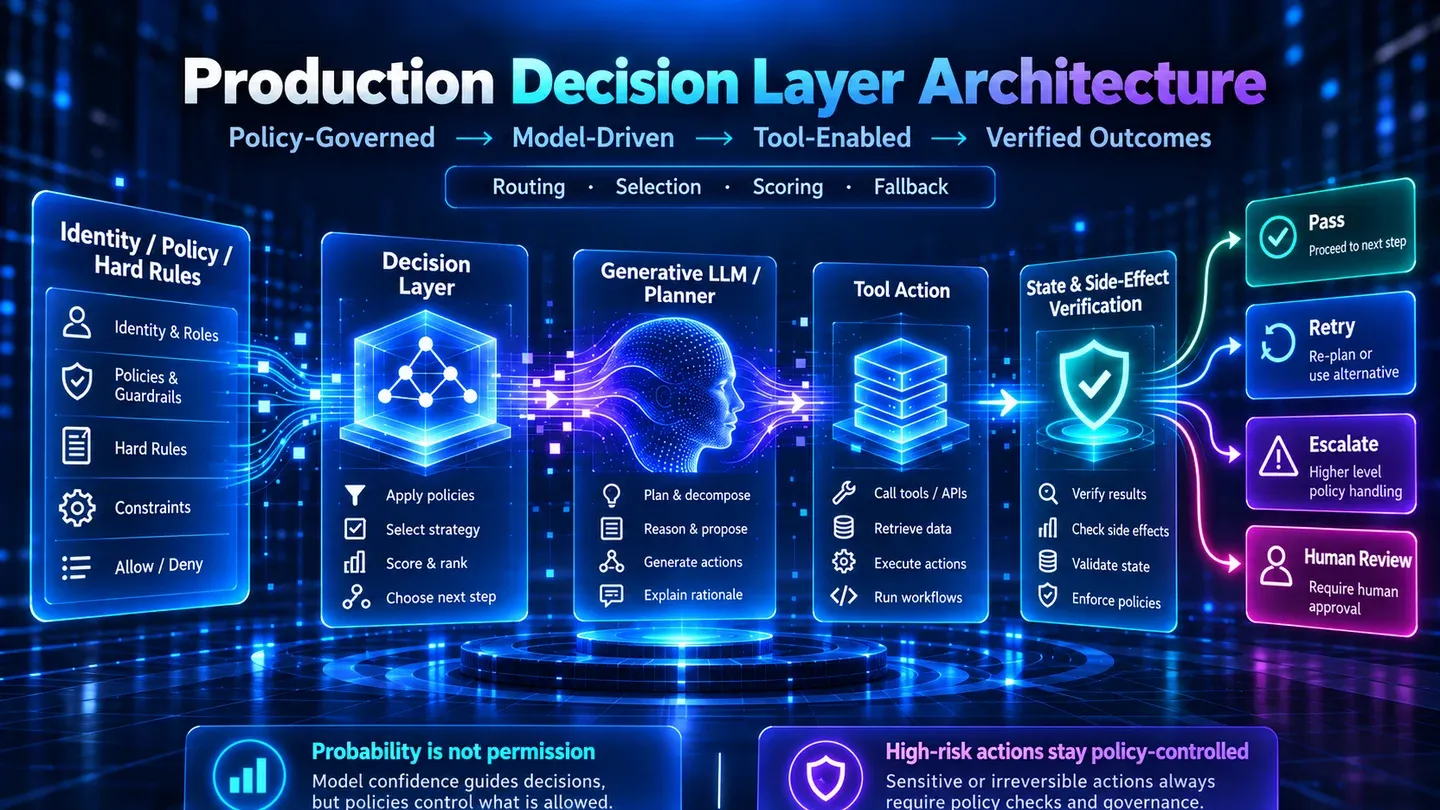
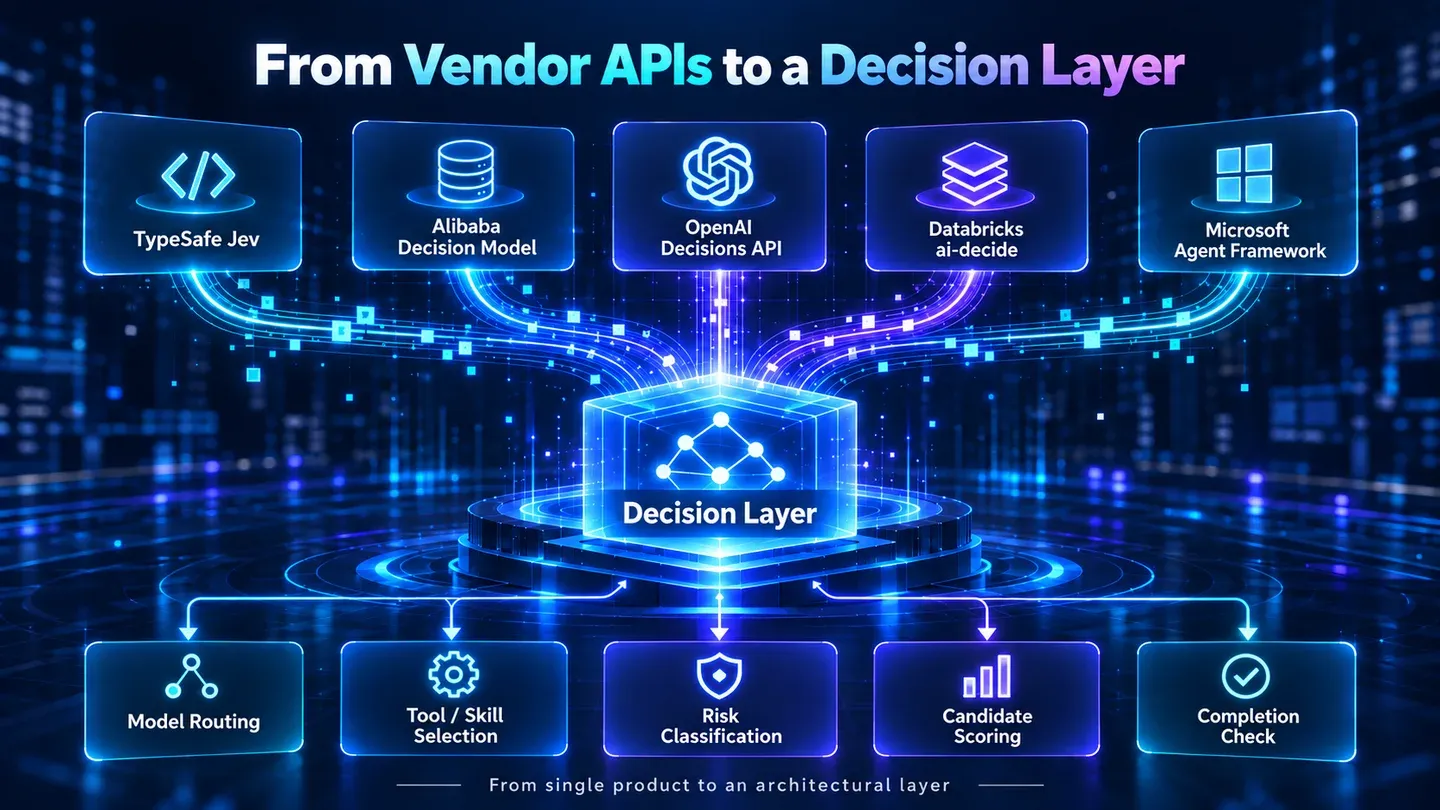
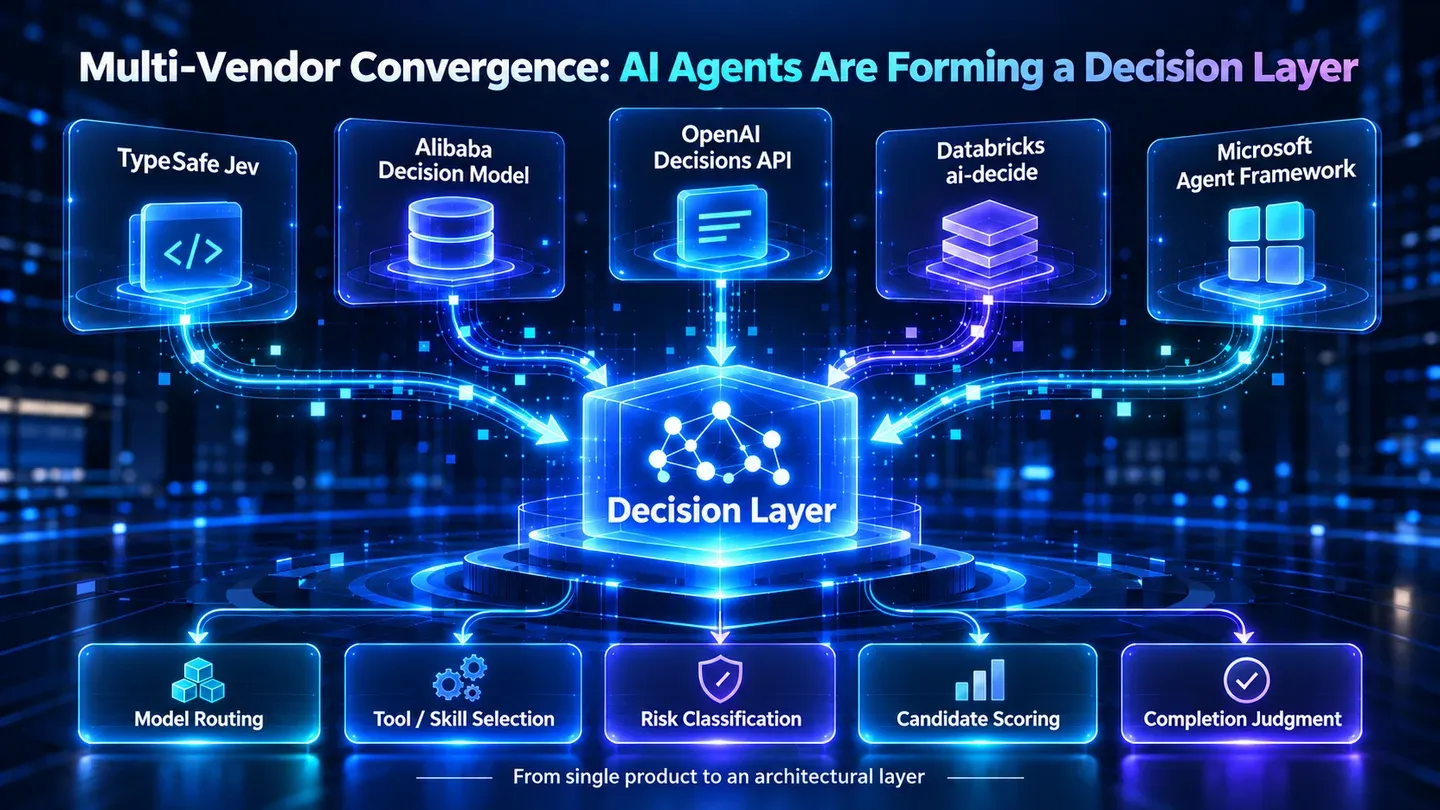
From September to October 2026, Jev, Alibaba Decision Model, OpenAI Decisions API, Databricks ai-decide and Microsoft Agent Framework proposals began converging on the same architecture: move bounded routing, scoring, tool/skill selection and completion checks out of generative LLM calls into a dedicated Decision Layer.
Evidence 10 cited sources
On this page
Short answer: production AI agents are starting to develop a Decision Layer that is distinct from generative LLM inference. Its job is not to write shorter answers. It handles the bounded decisions that occur repeatedly around generation: model routing, tool/skill selection, risk classification, candidate scoring, loop completion and escalation. Between September and October 2026, Jev, Alibaba Decision Model, OpenAI Decisions API, Databricks ai-decide and Microsoft Agent Framework proposals began converging on this same architectural split.
That convergence matters because agents waste surprising amounts of latency and money on tiny judgments. A system may call a full generative model to answer “yes or no,” pick one of five models, rank three tools, decide whether a loop should continue, then parse JSON and recover when the output drifts. As agents become longer-running, more tool-rich and more model-diverse, those control-plane calls multiply.
Decision models are easy to over-sell, however. A probability is not permission. A typed answer is not proof of correctness. Lower per-call latency is not automatically lower workflow cost. The durable question is therefore not which vendor replaces GPT or Claude. It is where rules, conventional classifiers, bounded decision models, generative LLMs and humans should each own the decision.
Why October 2026 looks like an architectural inflection point
When Jev launched on September 15, it was reasonable to view System One as one startup’s unusual model category. That interpretation is much harder to sustain now.
OpenAI released the Decisions API beta with gpt-6-luna on October 6, 2026. Its changelog says the API turns text and images into typed answers and can be about 10x faster than the Responses API for suitable tasks. The API reference makes the scope concrete: predicate estimates the probability that a statement is true, choice selects from caller-defined typed options and returns probabilities/confidence, and score evaluates ordered levels. Multiple questions can share one input. This is a bounded-decision interface, not a replacement for general agent reasoning.
Sources: OpenAI Changelog, Create a decision
TypeSafe AI released Jev on September 15 and framed it as a System One Model. The core product idea is similar: applications provide state and typed questions, then receive finite probabilistic decisions rather than prose. TypeSafe describes the pattern as “unstructured state in, typed probabilistic decisions out.”
Source: TypeSafe — Introducing System One Models & Jev
Alibaba Cloud published its Decision Model API on September 28. decision-model-preview supports choice, noul and score, with full probability distributions and confidence. Alibaba lists ticket routing, content moderation, agent routing and result verification among intended use cases.
Source: Alibaba Cloud Decision Model API
Databricks also exposes ai-decide in beta. Fast structured judgment is therefore becoming a platform primitive, not only an agent-startup feature.
Source: Databricks ai-decide
The framework layer is moving in the same direction. A Microsoft Agent Framework feature proposal discusses a provider-neutral decision-oriented abstraction and explicitly names loop evaluation, tool selection and skill selection as bounded tasks that may not need a full IChatClient. That proposal is exploratory rather than a shipped Microsoft API, but the architectural signal is important.
Source: Microsoft Agent Framework #8545
October 7 adds an on-device decision-model direction. Liquid AI released open-weight d1-3B and experimental d1-omni-600M on Hugging Face. The former supports text and images; the latter supports text plus images or text plus audio. Liquid AI reports a d1-3B Decision Index v0.2.1 score of 48.57 and Jetson latency figures. Those are vendor measurements, not XBSTACK iPhone/Mac benchmarks. Before treating either as a production Personal AI control-plane component, verify transformers>=5.14, trust_remote_code=True, device memory, quantization/runtime support, accuracy on your own labeled requests and fallback cost against rules, classifiers and cloud decision APIs.
Source: Liquid AI / Hugging Face: Multimodal open d1 decision models for the edge
A Decision Model is not just Structured Output
The superficial comparison is “both return JSON.” The deeper difference is the task objective.
A conventional structured-output LLM is still a generator whose final output is constrained by a schema. A Decision Model or decision-specific API starts from a bounded question space and returns a choice, score or probability directly.
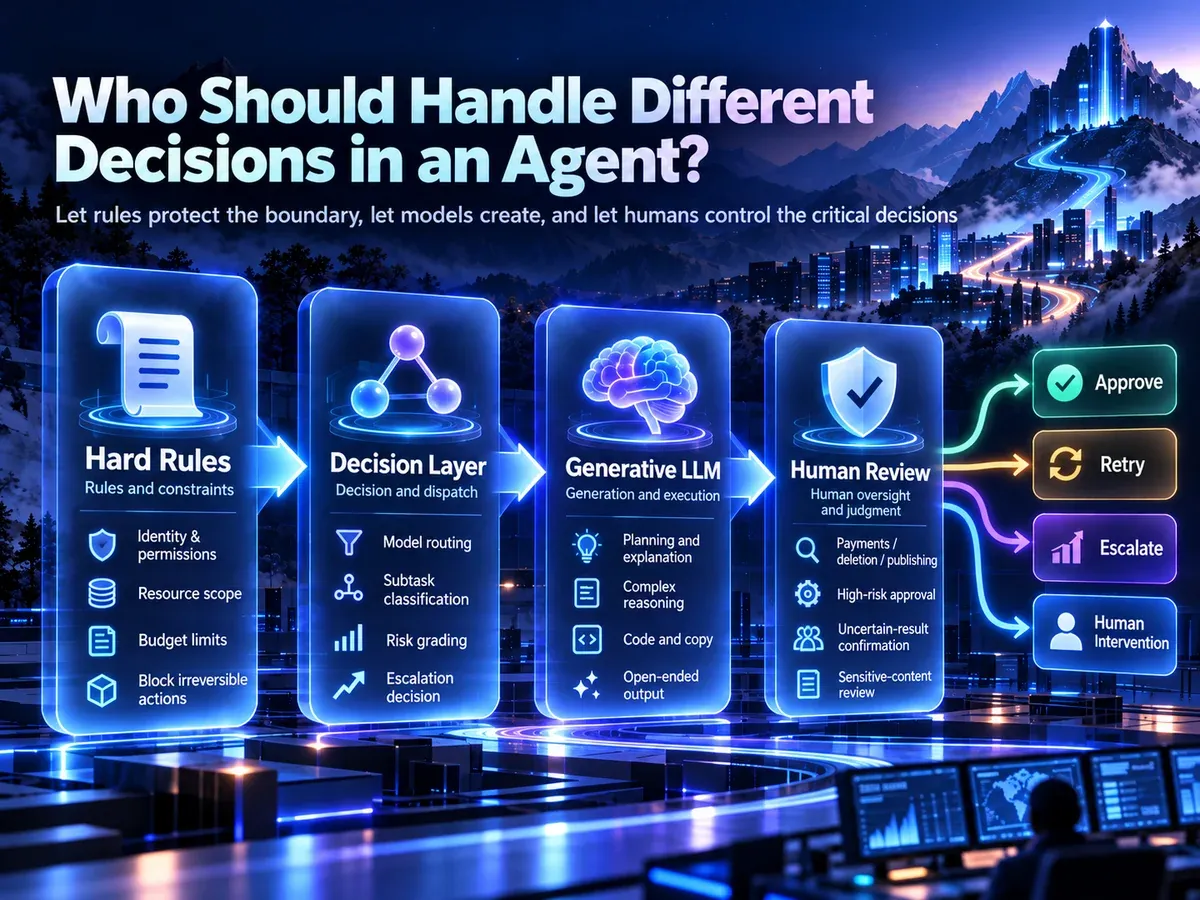
| Layer | Best fit | Output | Typical failure |
|---|---|---|---|
| Hard rules | authorization, capabilities, regulation, irreversible boundaries | allow / deny / require approval | missing or wrong rule |
| Traditional classifier | stable labels with training data | label / probability | distribution drift, label coverage |
| Decision Model | dynamic criteria, routing, scoring, finite choices | choice / score / probability | semantic error, poor calibration |
| Generative LLM | reasoning, planning, explanation, generation | text / tool args / structured object | hallucination, latency, cost, drift |
| Human review | high-risk or genuinely ambiguous decisions | approve / reject / correct | queue and labor cost |
Schema validity is therefore not correctness. A model can always return an allowed enum and still choose the wrong enum. Production evaluation must measure decision accuracy, calibration, false-safe / false-allow rates, fallback rate and verified task success.
Which agent steps belong in the Decision Layer?
The best candidates are the repeated control-plane decisions around the main reasoning call.
User intent
  ↓
Hard authorization / capability filters
  ↓
Decision Layer
  ├─ model routing
  ├─ tool shortlist
  ├─ skill / worker selection
  ├─ risk classification
  ├─ candidate scoring
  └─ loop completion
  ↓
Generative LLM / Planner
  ↓
Tool execution
  ↓
Terminal-state verification
  ↓
Fallback / Human review
Model routing is the obvious case. First remove candidates that fail deterministic constraints such as vision, context length, tool support or budget. A bounded decision layer can then select among the remaining viable models.
Tool and Skill shortlisting is another strong fit. Large agents may expose hundreds of tools and skills. A Decision Layer can reduce an already-authorized candidate set before the generative model sees it. The order must remain authorization → semantic selection; the decision model must never expand permissions.
Loop completion can also become a bounded decision. Agents repeatedly ask whether a task is complete, should retry, should escalate or needs another tool. Those states often do not require a full prose-generating judge.
Risk classification and result scoring are useful signals as well, but they must not replace actual terminal-state verification. XBSTACK already separates “the model said it finished” from “the backend reached the right state” in the AI Agent Evaluation guide and Agent Side-Effect Evaluator. A Decision Model can route or score that evidence; it should not become the evidence itself.
Confidence is not permission
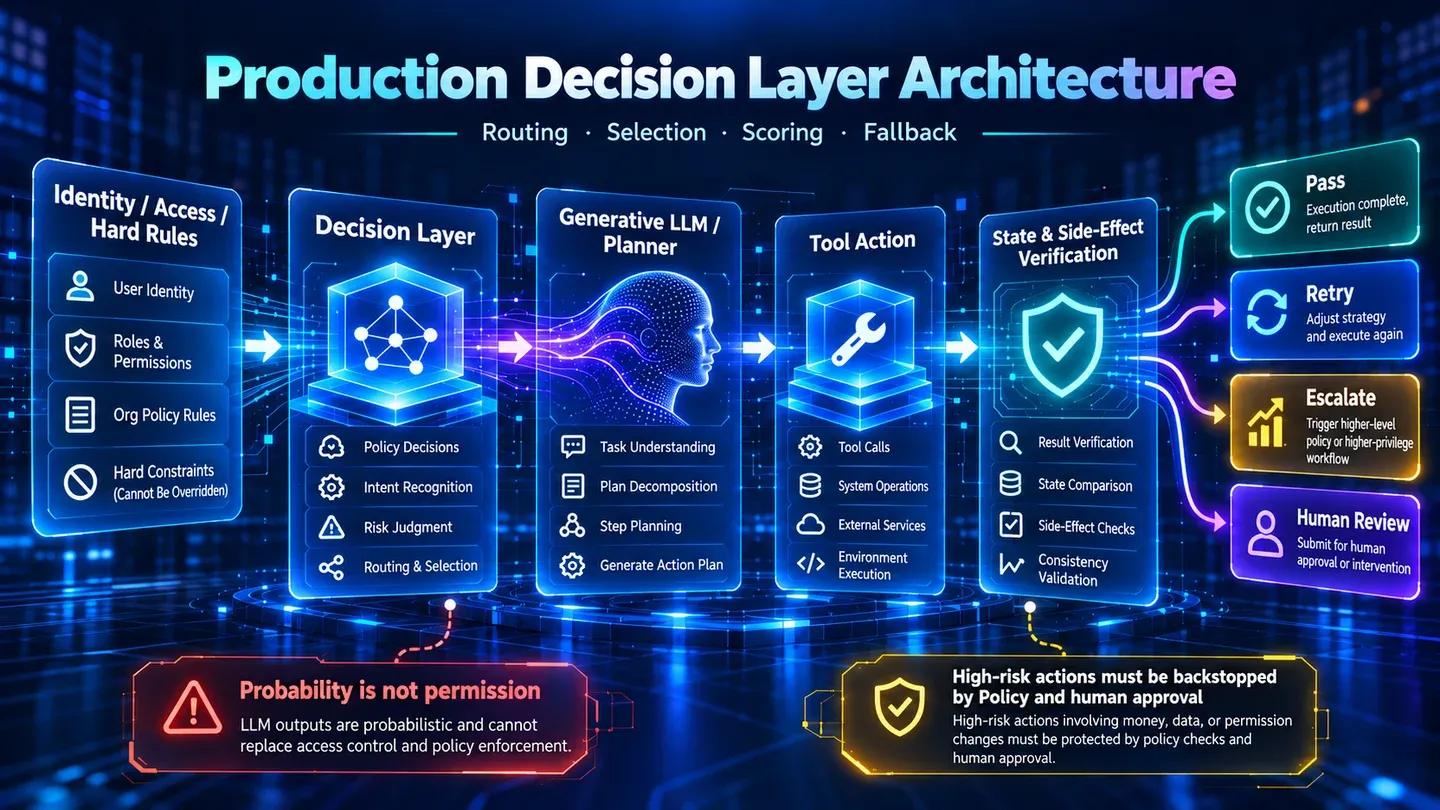
This is the most important production boundary.
The following should remain deterministic policy or explicit approval:
- identity and resource authorization;
- tenant and file scope;
- payments, transfers, deletion and production publishing;
- access to credentials and private data;
- compliance requirements;
- kill switches, spend caps and rate limits;
- mandatory confirmation for irreversible actions.
A Decision Model may predict that a tool call looks destructive. It still does not own the authority to run the call. The safe composition is semantic signal from the model, authority from the Policy Engine. That matches the separation in XBSTACK’s AI Agent Tool Authorization / Policy Gate.
How to choose between rules, classifiers, Decision Models and LLMs
Replacing “everything uses an LLM” with “everything uses a Decision API” creates a new single point of failure. Start with the shape of the task.
Fixed hard boundaries → Rules. Production deletion requires approval, a tenant cannot read another tenant’s files, or a model does not support images. Deterministic facts should stay deterministic.
Stable labels + sufficient training data → Traditional classifier. If a support system has 20 long-lived intents and years of labels, a fine-tuned classifier may be cheaper, more controllable and fully local.
Changing criteria + finite output space → Decision Model. Dynamic model pools, changing tool catalogs, configurable reviewer thresholds and continue/stop/escalate decisions are stronger candidates.
Complex reasoning, planning or explanation → Generative LLM. If the answer space is not bounded, or the task requires cross-domain reasoning, code generation or a multi-step plan, a Decision Model is the wrong abstraction.
High risk + high uncertainty → Human review. Payments, legal commitments, production deletion and privacy-sensitive export should treat escalation as a normal system state rather than a failure.
What existing Jev benchmarks prove — and what they do not
The strongest material from the earlier Jev-focused version of this page remains useful because it evaluates a real agent control-plane task.
themsquared/jev-benchmark publishes 60 hand-labelled agent tool calls: 34 clear, 14 ambiguous and 12 adversarial, classified as readonly, destructive, privileged or exfiltration. Under one task definition, the repo reports 55/60 (91.7%) accuracy for jev-latest, jev-preview and Claude Sonnet 5; every backend scores only 71.4% on the ambiguous slice. The author measured Jev p50 latency around 378–422 ms versus 1371 ms for Claude Sonnet 5 and reported a large estimated per-call cost gap.
Those are third-party measurements on one dataset, one network path and one price snapshot, not XBSTACK measurements. The useful finding is not “Jev wins.” It is that a frontier LLM bought no extra accuracy on this narrow typed task, while ambiguous taxonomy boundaries hurt every backend. Better labels and policy may matter more than a bigger model.
Source: themsquared/jev-benchmark
A routing experiment provides the more important counterexample. TokenTrim/jev-routing-experiment adds a Jev difficulty signal to RouterArena/LLMRouterBench routing, but also runs a no-Jev ablation. Published results show retrieval evidence preserving the main improvement even when the Jev signal is removed.
That means a Decision Model must earn its place through ablation, not correlation.
Rules only
Rules + retrieval
Rules + classifier
Rules + Decision Model
Rules + retrieval + Decision Model
Structured-output LLM router
Source: TokenTrim/jev-routing-experiment
dhruvmehra/jevbench broadens the baseline set to Jev, an open System One model, a small LLM, a frontier LLM, fine-tuned DistilBERT and BART-MNLI zero-shot NLI. That is closer to the engineering decision teams actually face: a Decision Model must show incremental value over rules and classifiers, not only over an expensive frontier model.
Source: dhruvmehra/jevbench
Why Personal AI makes the Decision Layer more important
A Personal AI Agent combines long-term memory, identity, cross-app actions, credentials and background execution. It repeatedly needs decisions such as: should this state remain local or go to the cloud? Which app can satisfy this intent? Should the user approve this action? Should the task use a local small model, a cloud frontier model, or no model at all?
That makes a Decision Layer a natural component inside the runtime/policy boundary described in Personal AI Agent Architecture, but data boundaries must come before model capability.
Sensitive memory, credentials and private documents should not be uploaded wholesale just to obtain a cloud decision. State should be minimized, redacted and scoped before any external decision service sees it. If the product requirement is “data never leaves the device,” local classifiers, open small models and deterministic rules remain the proper baselines.
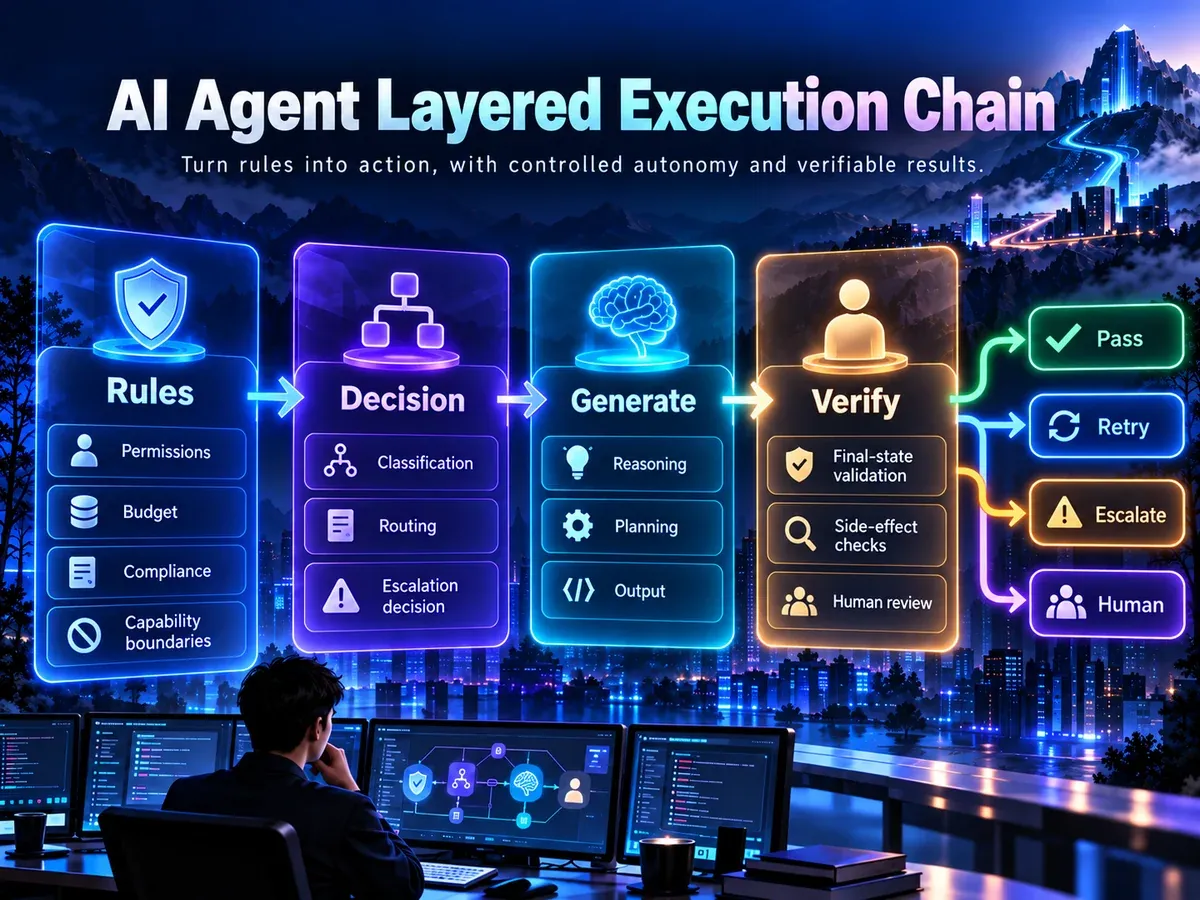
A production pattern: Rules → Decide → Generate → Verify
A safer control plane has four layers.
First, Hard Rules / Capability Filters own permissions, regulation, budgets, model capabilities, tenant boundaries and irreversible operations.
Second, a Decision Layer handles bounded semantic judgments: routing, selection, scoring, escalation and loop completion. The implementation may be a traditional classifier, OpenAI Decisions API, Jev, Alibaba Decision Model or another provider behind a neutral interface.
Third, the Generative Layer handles reasoning, planning, tool arguments, code, explanations and open-ended output.
Fourth, Verification / Human Review checks backend state and side effects, with human approval for consequential outcomes.
Identity / Policy / Capability
          ↓
     Decision Layer
          ↓
 Generative LLM / Planner
          ↓
      Tool Action
          ↓
Terminal State / Side Effect Check
          ↓
  Pass / Retry / Escalate / Human
The goal is not to add another model. It is to give different kinds of decisions different owners.
What XBSTACK should benchmark next
It is too early to claim “OpenAI Decisions API beats Jev” or “Decision Models are N times cheaper than LLMs.” The useful next step is a provider-neutral harness.
Model routing: label real development, operations and content tasks. Compare rules, a conventional classifier, a Decision Model, a structured-output LLM and retrieval-enhanced combinations. Measure routing regret, downstream task success and cost per verified task rather than label agreement alone.
Tool/Skill shortlisting: select from already-authorized candidate sets. Measure recall, context reduction, final tool-selection success and false omission.
Confidence fallback: deliberately add ambiguity, missing fields, adversarial phrasing and boundary cases. Measure calibration, false-safe rate, fallback rate and human-review rate.
End-to-end cost: include decision calls, generative calls, tools, retries, fallbacks, human review and rework caused by bad routing. Only then can a cheap decision call be credited with reducing total agent cost.
October 12, 2026: Claude Haiku 5.5 Agent Routing and the 100K Token Pricing Boundary

The 100K-token marker is a pricing and context-budget threshold, not an automatic human-approval trigger. Actual approvals depend on permissions, sensitivity and irreversible side-effect risk.
Official documentation and hypothetical pricing analysis—not an XBSTACK hands-on test. Anthropic launched claude-haiku-5-5 on October 7 for high-volume classification, routing and subagent work. Its standard text rates are USD 0.10 per million input tokens and USD 0.50 per million output tokens for prompts up to 100K input tokens, rising to USD 0.50 and USD 2.50 when a prompt exceeds that threshold. GPT-6 Luna’s applicable standard text rates start at USD 0.10 / USD 0.50. Matching list rates are not matching cost per verified task: model tokenizers, thinking tokens, context growth and retries affect real spend. Under an artificial assumption of identical token counts and uncached standard requests, 20K input + 1K output would cost about USD 0.0025 for either; 120K input + 3K output would cost about USD 0.0675 with Haiku 5.5 versus USD 0.0135 with Luna. These are illustrative list-price calculations, not observed API bills, accuracy or latency results.
XBSTACK prepared 14 author-written cases covering categorization, diagnostics, consequential tool actions and approval escalation to compare Haiku Messages with Luna Responses under shared output labels. The current execution environment lacks both providers’ API credentials: only fixtures and price arithmetic have been validated, no model inference has been run. OpenAI’s separate Decisions API returns typed choice/predicate/score answers, so testing it alongside general generation requires a distinct measurement lane. For payment, deletion or production deployment, neither a small model nor a confidence value should supersede deterministic authorization and human review.
Until those hands-on measurements exist, XBSTACK’s position is deliberately narrow: Decision Layer deserves to become a first-class agent architecture concept, but it should not become a new universal-model layer.
Final decision
When Jev appeared in mid-September, the interesting question was whether one new model category deserved attention. By October 7, OpenAI, Alibaba, Databricks and Microsoft Agent Framework activity changed the search task.
The durable question is now:
Which parts of an agent never needed open-ended generation in the first place, and should those bounded decisions become a calibrated, replaceable Decision Layer?
My answer is yes. The right position is after hard rules and before generative LLMs, with policy, verified system state and humans still owning consequential boundaries.
That is a more durable 6–24 month architecture problem than any one Decision API release.
FAQ
What is an AI Agent decision model?
It is a model or inference API for bounded decision spaces. The caller supplies input/state plus a finite question space, and receives probabilities, choices or ordered scores. It fits routing, scoring, shortlisting and completion checks better than open-ended generation.
OpenAI Decisions API vs Responses API: what is the difference?
The Decisions API is currently a beta bounded-decision surface with predicate, choice and score questions. The Responses API is a general generation/reasoning surface. OpenAI says Decisions can be about 10x faster on suitable tasks; that figure is an official product claim, not an XBSTACK benchmark.
Can a Decision Model replace a traditional classifier?
Not automatically. A fine-tuned classifier may win when labels are stable and training data is available. Decision Models become more attractive when criteria or candidate sets change dynamically. Test both on the actual workload.
Can model confidence control tool authorization?
No. Confidence can support risk classification or escalation, but identity, resource scope, payment, deletion, publishing and other consequential permissions should remain under deterministic policy and explicit approval when required.
Has XBSTACK benchmarked OpenAI Decisions API against Jev?
Not in a matched hands-on harness yet. This page separates official product capabilities, reproducible third-party benchmarks and XBSTACK’s still-pending test plan; it does not claim a default winner.
Sources
- OpenAI API Changelog — Decisions API beta
- OpenAI API Reference — Create a decision
- Anthropic — Claude Haiku 5.5 launch and rates
- Claude Platform — Haiku 5.5 model overview
- OpenAI — GPT-6 Luna model reference and rates
- TypeSafe AI — Introducing System One Models & Jev
- Alibaba Cloud — Decision Model API
- Databricks — ai-decide API
- Microsoft Agent Framework — decision-oriented inference proposal
- Independent — Agent Tool-Call Risk Benchmark
- Independent — Jev Routing Experiment
- Independent — Jev vs LLM / BERT / NLI
Continue reading
- Personal AI Agent Architecture: Memory, Permissions, Cross-App Actions and Runtime
- AI Agent Tool Authorization and Policy Gate
- AI Agent Evaluation: From Traces to Terminal State and Side Effects
- AI Agent Production Governance: Routing, Permissions, Cost and Rollback
Continue from one agent pattern to the complete production system
The AI Agent hub organizes architecture, memory, tool use, evaluation, security, deployment and multi-agent coordination into a single learning path.
Next step: harden the execution boundary
Full decision path →Continue with the control that should be enforced before the next tool call, credential handoff, or production rollout.

DISCUSSION
Questions, verification and corrections
Sign in to comment. Every new comment is reviewed before publication; while pending, it is visible only to you and the administrator.